Does Google Street View Direct Mail Work for Insurance Agencies?
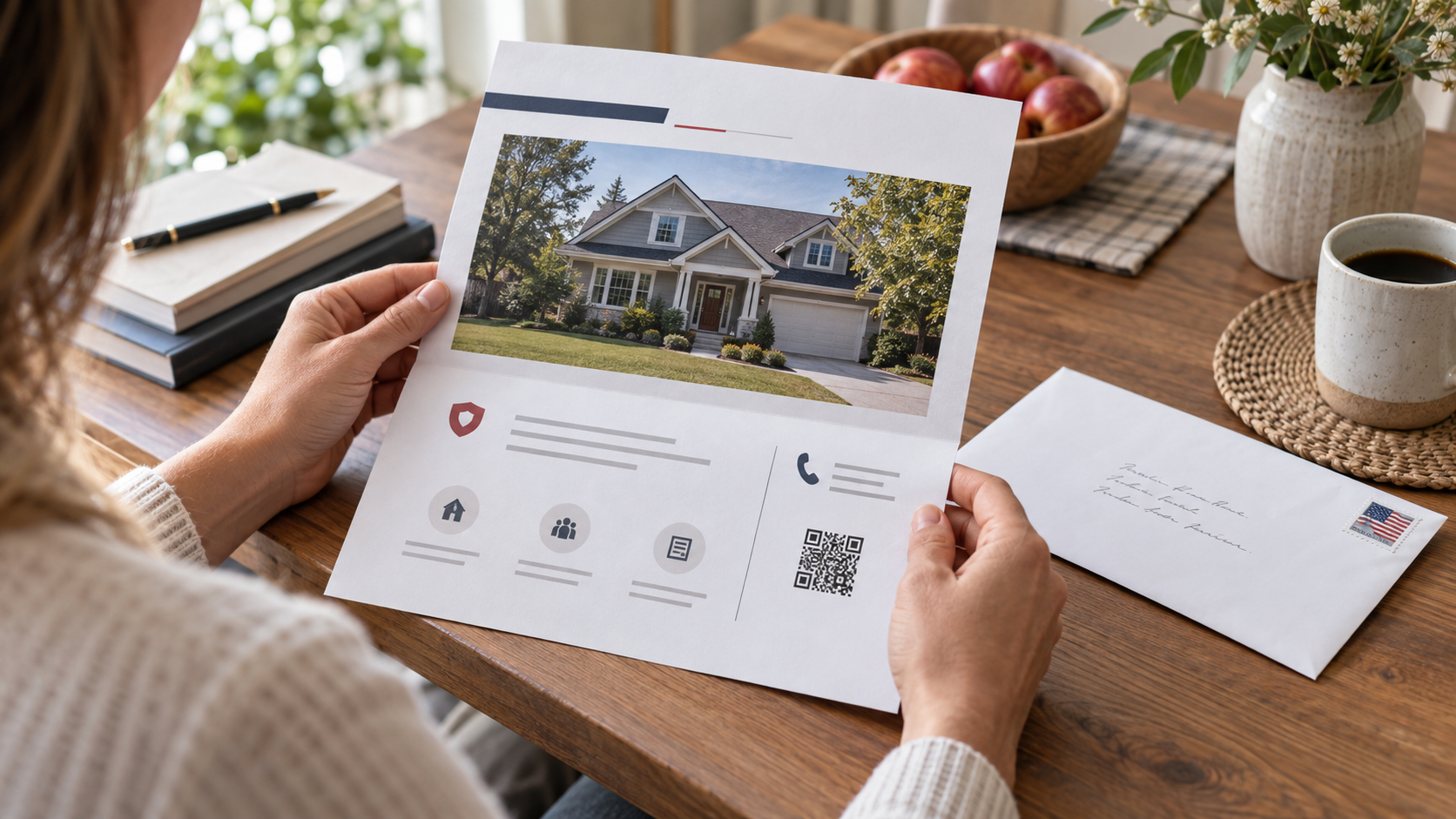
Google Street View direct mail can help insurance agencies earn more attention by placing a recognizable image of each recipient’s home directly on the letter. The image does not guarantee a response, but it can make an insurance offer feel more personal, relevant, and difficult to overlook.
For insurance agencies, that distinction matters. Homeowners receive plenty of generic advertisements featuring stock photography and broad promises. Showing the recipient’s actual property immediately connects the letter to something they recognize and may soon need to insure or review.
Why does Google Street View direct mail earn attention?
Most direct mail asks the recipient to decide whether the message applies to them. A Street View image can answer that question before the homeowner reads the first paragraph.
When recipients recognize their own homes, they are more likely to pause and look at the rest of the letter. That interruption gives the headline, offer, agency information, and call to action a better opportunity to be seen.
The image is especially relevant for homeowners insurance because the property shown is directly connected to the product being offered. It is not simply a decorative image added to the design. It helps establish why the agency is contacting that particular household.
Does Street View increase direct mail response rates?
Street View personalization can make an insurance letter more noticeable, but it should not be treated as a guaranteed response-rate increase.
The image earns attention. The rest of the campaign must turn that attention into action.
Results still depend on:
- The households being targeted
- When the letters arrive
- The strength of the insurance offer
- The quality of the letter and envelope
- How clearly the recipient is told what to do next
- How quickly the agency follows up with inquiries
A recognizable home image cannot compensate for poor targeting, confusing copy, or an offer that gives the homeowner no reason to respond. Its value is giving a well-planned campaign a stronger opportunity to be noticed.
How is Street View different from basic personalization?
Basic direct-mail personalization may include the recipient’s name, address, city, or ZIP code. Those details can make a letter feel more relevant, but homeowners are accustomed to seeing their names inserted into marketing materials.
Google Street View direct mail changes a prominent visual element for every recipient. Instead of using the same stock house across an entire campaign, each letter can feature imagery matched to the individual mailing address.
One campaign may include thousands of letters, but every recipient can receive a version connected to their own property.
What makes a Street View campaign work?
Street View performs best when it supports a complete insurance direct-mail strategy.
Accurate household targeting
The mailing list should reflect the agency’s preferred geography, property type, home value, household characteristics, and carrier appetite. Sending a personalized letter to an unsuitable household still wastes the cost of production and postage.
Relevant timing
A homeowner is more likely to consider an insurance offer when there is a reason to review coverage. Street View can be paired with estimated renewal-date targeting so the letter arrives before a potential insurance decision window.
An envelope that gets opened
The property image only works if the recipient sees the letter. A handwritten-style envelope, live stamp, personalized address, and restrained exterior design can help the package feel more personal than ordinary advertising mail.
A credible offer
Once the image earns attention, the letter must provide a clear reason to respond. That might be an invitation to compare coverage, request a homeowners quote, review a home and auto bundle, or speak with a local agent.
The phone number, QR code, and next step should be easy to find.
Which insurance campaigns are best suited for Street View?
Street View personalization is most useful when the home is central to the message. Strong applications include:
- Homeowners insurance acquisition
- Estimated renewal-date campaigns
- High-value home targeting
- Home and auto bundle offers
- Coverage-review campaigns
- New-homeowner outreach
- Selected neighborhood campaigns
It may be less important for a broad awareness campaign or a product unrelated to the recipient’s property. The image should strengthen the reason for the letter rather than being used only as a novelty.
Does showing someone’s home feel intrusive?
Seeing a familiar property image can create a strong reaction, which is part of what makes the format noticeable. The campaign must use that attention responsibly.
The letter should clearly identify the insurance agency and explain the offer without suggesting that the property was inspected or that the agency has access to private policy information. Street View imagery should be presented as a visual connection to the homeowners insurance message—not as a scare tactic.
Images may also be older than the current appearance of the property. Landscaping, renovations, and other details may have changed. The letter should not make claims about the home’s present condition based on the image.
What happens when a property image is unavailable?
Not every address will have a usable image. A property may be blocked by trees, incorrectly centered, recently constructed, located on a private road, or unavailable from the appropriate angle.
A clean fallback design should be used when the correct image cannot be confidently matched. An unsuitable image can weaken the credibility that personalization is intended to create.
Image matching, mailing data, address hygiene, and production quality control are therefore important parts of the campaign.
Frequently asked questions
Does every homeowner receive a different image?
Yes. In a fully personalized campaign, the property image changes with each mailing record. The recipient’s name, address, message, and response information can also be personalized.
Can Google Street View imagery be printed on direct mail?
Google imagery is subject to licensing and usage requirements. Vesper Marketing produces these campaigns through a third-party production provider that maintains the appropriate print rights for the imagery used.
Can Street View be used on letters and postcards?
Yes. However, a letter inside a handwritten-style envelope creates a more private and premium presentation. A postcard places the property image immediately in view but offers less privacy.
Is Street View enough to make a campaign successful?
No single creative feature guarantees results. Street View is most effective when combined with qualified targeting, relevant timing, strong copy, a credible offer, and a dependable follow-up process.
The image earns attention—the campaign creates the response
Google Street View direct mail works by making an insurance message feel specific to the household receiving it. A recognizable property image can encourage the homeowner to pause, open the letter, and consider the offer.
The strongest campaigns do not rely on the image alone. They combine Street View personalization with the right audience, an appropriate renewal window, a personal envelope, a clear insurance offer, and an easy response path.
Vesper Marketing helps insurance agencies manage that entire process, from homeowner targeting and personalized creative through printing, mailing, and campaign tracking.
Explore our insurance direct mail services or send us the ZIP codes and homeowner criteria you want to target. We can build the available count and recommend a practical starting point.